
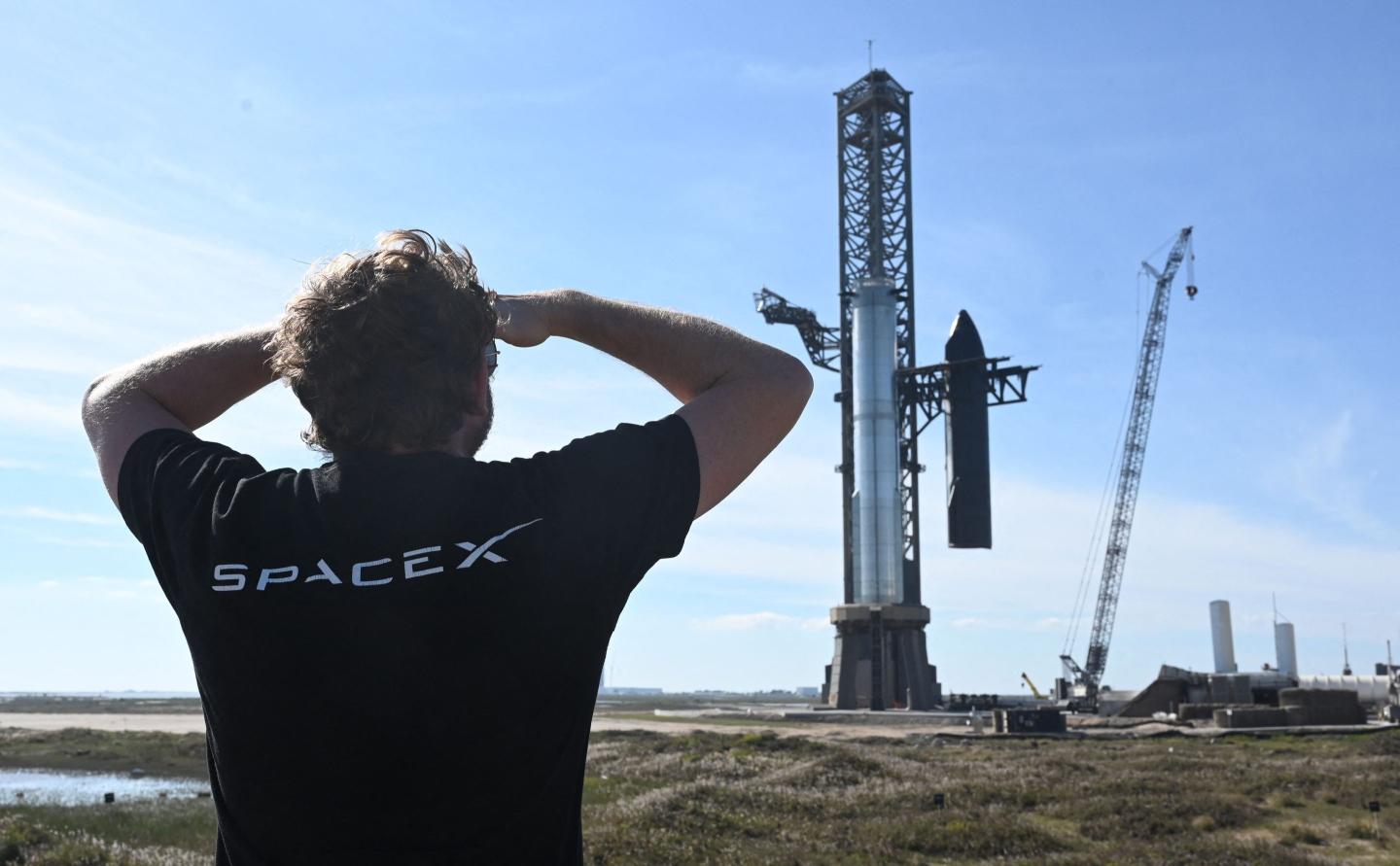
SpaceX CEO Elon Musk described plans to build factories on the moon as he presided over the now public rocket maker’s first earnings call this month. Even Musk admitted it all sounded “totally nuts.” But while Musk’s rhetoric and his timing estimates often don’t line up with reality, he’s not alone in seeing opportunity on the moon. Now, a new report is offering a look at the financial underpinnings of what could become a vast $566 billion lunar economy, and the ripple effects that could double it to more than $1.1 trillion.
The new report by advisory firm Deloitte and shared with Fortune in advance of its Wednesday release, estimates the budding moon-based economy could generate between $343 billion and $566 billion in upside through 2050. The range represents a conservative- to accelerated-growth scenario based on how quickly infrastructure, energy, and transportation services can get up and running on the moon, and then how quickly commercial businesses follow—which is no small feat. The most bullish scenarios also hinge on whether several bleeding-edge technologies advance over the next two decades, including rocket fuel made from water ice at the lunar poles, extraction of helium-3 to cool quantum computers, and AI data centers built to orbit the moon’s surface.
And despite the high barrier to entry for non-aerospace businesses, new companies are getting in on the action. Luxe fashion brand Prada used its textiles expertise to help design spacesuits that can withstand extreme temperatures. Sunglasses brand and optical manufacturer Oakley developed a gold-plated visor for astronauts for use in both darkness and under direct exposure to the sun. Deloitte also has a stake in the success of space, and has launched a cyber detection system, Silent Shield, which is now part of one of Nasa’s moon initiatives.
“What was once the domain of governments and a handful of aerospace contractors now includes venture-backed startups, investors, defense firms, and some of the world’s largest companies all seeking a role in the emerging lunar economy,” the report states. “Although still in its earliest stages, the upside potential could be massive.”
The report, “Building the Lunar Economy,” includes insights from interviews with founders, engineers, investors, and government officials, and more than 400 model inputs. It maps out the infrastructure required for working on the moon, including the transportation, energy, communications, surface mobility, and life support needed—and it considers the unpredictable innovations and value that could be unlocked when humanity enters this new realm.
Why now?
Brett Loubert, who leads Deloitte’s space practice and co-authored the report, said momentum in the sector took on even greater intensity last year, which was also a record for venture capital investment in space technology. Seraphim’s space tracker report saw $7.5 billion investment in Q2 of 2026, with trailing 12-month investment at an all-time-high of $23 billion.
“What you’re seeing generally is excitement in and outside the industry for what is an explosion of data sources and services that are being delivered from orbit and beyond,” said Deloitte’s Loubert.
Another major catalyst for the commercial momentum is inarguably SpaceX itself, which has Musk behind it as founder, CEO, and hype man for both the company and for space as a mainstream concept. SpaceX went public in a record-setting IPO on June 12, which saw its valuation soar to $2 trillion. Its market cap has since slipped to $1.8 trillion but Musk, who controls the majority of SpaceX through his ownership, has a knack for drumming up interest from retail and institutional investors in his companies and SpaceX has not, thus far, shown it will be any different.
In the weeks before it went public, SpaceX headlines focused on the company’s interplanetary Mars mission and Musk’s goal of establishing a human colony on the planet with 1 million inhabitants. But weeks after the largest IPO in history, Musk talked more about the moon during SpaceX’s first earnings call, which investors say is a strategic threshold that will likely be crossed before SpaceX can fully set its sights on Mars.
SpaceX has already invested more than $15 billion in its massive Starship rocket, designed to carry up to 100 metric tons to orbit and, eventually, the company hopes, transport passengers and equipment to Mars. On the most recent earnings call SpaceX President Gwynne Shotwell laid out near-term milestones that included an Artemis III ship docking in 2027 and “boots on the moon in 2028.”
Ex-SpaceX employees have also struck out and forged their own space mobility and infrastructure businesses with 141 companies cropping up worth $10.6 billion, according to Forbes. An analysis of publicly disclosed equity rounds by space companies between August 2025 and July 2026 found 47 deals with a median round size of $40 million, and an average round size of $116.2 million, according to New Market Pitch. Spacecraft manufacturers dominated, raising $2.3 billion in 26 deals and representing 43% of the capital raised.
Musk meanwhile, continues to add his unparalleled brand of boosterism to the space sector, moving SpaceX’s internal projection for hitting $1 trillion in revenue forward from 2031 to 2030 during the SpaceX earnings call (much of the lofty revenue target is based on the company’s AI business accelerating).
The Deloitte Numbers
The Deloitte report’s $566 billion high-growth scenario breaks down into two value pools. The first, “core lunar activity,” refers to the foundational lunar infrastructure that has to be built before anything else can really happen. Getting to and from the moon, transportation and energy once you’re there, and dealing with the surface regolith—the moon’s jagged specks of dust—make up $206 billion of that total, more than a third. Power tacks on another $44 billion. Communications, surface mobility, construction, and life support make up the rest of the first pool, which Deloitte estimates could generate an estimated $282 billion through 2050.
The second value pool refers to “enabled activity,” and describes potential downstream markets that could unlock to the tune of $284 billion because of the infrastructure, power, and transportation foundation from the first pool. Under the accelerated-growth scenario, the market for new resources and materials could grow to $114.5 billion, primarily driven by rocket propellant made from lunar water ice and helium-3. The latter is a rare isotope embedded in lunar soil that could become a major fuel source and has a use for cooling quantum computing systems. The report values in-space production in the high-growth scenario at $105.9 billion.
As for fuel, the further out in space you want to go, the more fuel you need, and figuring out how to extract lunar propellant in space is one of the major challenges companies are trying to solve. A single kilogram of rocket fuel costs $1 on Earth, $4,000 in low Earth orbit, and $36,000 on the lunar surface if it goes up from home, the report states. On the other hand, water ice in lunar soil can be processed into liquid oxygen and liquid hydrogen, which can be used as rocket fuel.
“Water ice is the oil of the moon,” economist Jim Zukin told Deloitte, per the report. It goes on to state: “If unlocked at scale, it could do for space what gas stations did for the road: reduce the cost of existing trips, and make entirely new ones possible, creating a network linking every station, city, and state with fuel and a delivery infrastructure.”
While lunar propellant is nowhere close to scaling, the case for compute is moving much faster. Google has announced its Project Suncatcher, which would put satellite clusters in orbit for compute, and Nvidia-backed Starcloud launched a satellite last year with an H100 Nvidia chip built for space which it used to train an AI model in orbit, the report notes. SpaceX has asked the FCC for permission to launch 1 million satellites to support data centers in space. The thinking is that orbital data centers can leapfrog past some of the ground-level issues such as where to build them, and upset communities that don’t want to host data centers, despite their municipalities making deals for construction.
“Data-processing satellites benefit from space’s unique conditions, offering near-continuous access to solar energy and radiative cooling,” the report states. “However, the challenge is scale.”
Things We Haven’t Imagined Yet
Beyond core lunar activity and enabled activity, there is also innovation spillover, human inspiration, and the value of research and potential opportunities that haven’t been imagined yet, said co-author Raquel Buscaino, who leads Deloitte’s Novel & Exponential Technologies team.
Deloitte pins the unimagined cascade effect at an additional $541 billion and did not add it to the final estimate to avoid overstating the size of the lunar economy. However, taken with the high-growth scenario, this pushes the lunar economy above $1.1 trillion, although there is a healthy dose of uncertainty to go along with that figure. Buscaino said uncertainty is a feature and not a flaw when it comes to space.
“There is extraordinary possibility and it’s also extraordinarily hard to do those things,” she said, referring to the opportunities the report lays out. People are excited because there are early demand signals on infrastructure and on the early markets, Buscaino added.
“Some of these distant opportunities could have extremely large upsides, and we don’t know which ones will pan out, or if what will ultimately matter the most could be a market that we haven’t imagined yet.”
Editor’s Note, August 26, 2026: This article was updated to note that Deloitte has an investment in the space business through its Silent Shield cyber detection system.